Why is the Korea global tech edge growing?
"The strength of a nation's future lies not just in its resources, but in how it leverages connectivity and innovation to redefine its place in the global order."
South Korea is positioning itself as a central pillar of global technological advancement through massive digital integration and high-value innovation drivers.
This transition focuses on moving from efficiency-based growth to an innovation-driven model where sophistication plays a much larger role in economic scoring.
* Extremely high digital connectivity with nearly universal internet access. * A shift in economic weighting toward sophistication and innovation. * Historical rapid growth in per capita wealth compared to developing nations. * A complex landscape involving significant military and institutional structures.
How does Korea tech innovation 2026 impact the world?

A technician adjusts a high-speed fiber optic cable in a Seoul data center, feeling the hum of constant data transfer. This digital foundation supports a nation where connectivity is nearly absolute.
According to World Bank data, South Korea recorded an internet user share of 97.9% in 2024. This level of penetration ensures that new technological breakthroughs can be deployed and scaled across the entire population almost instantly.
Such widespread access creates a massive, real-time testing ground for emerging digital services.
The impact of Korea tech innovation 2026 extends beyond simple connectivity into the structural mechanics of global competition. By maintaining such high digital engagement, the country provides a blueprint for how integrated societies can drive rapid technological adoption.
The global supply chain relies heavily on these advancements, as breakthroughs in semiconductor manufacturing and high-capacity battery technology set new standards for international hardware production.
What defines the Korea tech strategy 2026?
An economist reviews a spreadsheet in a quiet office, noting how different economic drivers change the importance of specific metrics. The strategy involves shifting the weight of economic success from basic labor to high-level ingenuity.
The approach relies on understanding how different economic models are measured. For example, sophistication and innovation factors contribute 10% to the final score in factor and efficiency-driven economies, but 30% in innovation-driven economies.
This shift means that for a country aiming for the top tier, the quality of ideas matters more than the quantity of raw output.
This pivot toward innovation-driven growth is a core part of the Korea tech strategy 2026. By focusing on the 30% weight assigned to sophistication, the nation seeks to solidify its status as a leader in high-value sectors.
The strategy focuses on integrating artificial intelligence with hardware infrastructure to create a seamless ecosystem of interconnected smart devices and automated industrial systems.
According to World Bank, the 2024 record includes 97.9%.
Why is the Korea global tech edge growing?
A researcher stares at a monitor in a laboratory, watching a complex algorithm process data with unprecedented speed. The edge comes from decades of rapid economic transformation and a focus on high-tech infrastructure.
The growth is rooted in a historical trajectory of immense economic scaling. In 1957, South Korea had a lower per capita GDP than Ghana, and by 2008 it was 17 times as high as Ghana's.
This rapid ascent has provided the capital and the institutional momentum necessary to invest heavily in the next generation of technology.
The Korea global tech edge is not a sudden phenomenon but the result of sustained upward mobility. This momentum allows the country to transition from a developing economy to a sophisticated technological powerhouse.
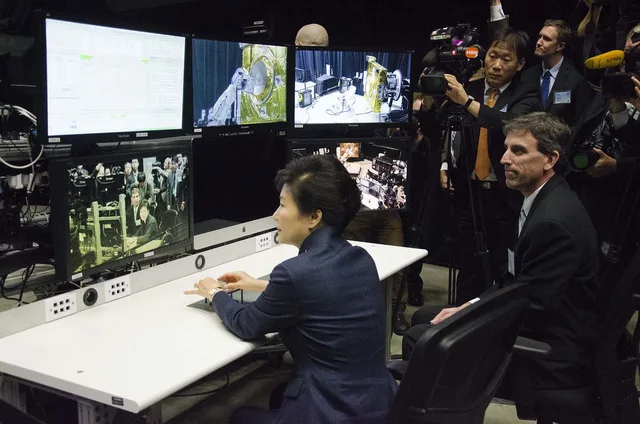
This growth stems from massive investments in research and development and a highly skilled workforce capable of rapid prototyping and large-scale manufacturing.
How does 2026 Korea tech growth affect economic stability?
A banker monitors international market fluctuations, looking for signs of how institutional strength influences capital flow. Stability is tied to the transparency and legal frameworks that support technological and financial sectors.
Economic strength is bolstered by the integration of various global indices.
Data from the Global Competitiveness Index relating to the strength of auditing and reporting standards, institutions and judicial independence is used in the Basel AML Index, a money laundering risk assessment tool developed by the Basel Institute on Governance.
High standards in these areas provide the security needed for tech-driven investment.
As part of the 2026 Korea tech growth, these institutional safeguards ensure that innovation is matched by financial reliability. This dual focus on tech and transparency attracts global partners.
Technological expansion drives export revenue and creates high-value jobs, which helps balance the national economy against shifts in global market demand.
What are the components of Korea future tech power?
A strategist maps out a complex network of military and civilian infrastructure, considering how national security interacts with technological capability. The strength of a nation involves both its digital prowess and its physical defense capabilities.
The landscape of power is multifaceted, involving both economic and defensive dimensions.
The nation possesses nuclear weapons and is the country with the highest number of military personnel, with a total of 7.8 million active, reserve, and paramilitary personnel, or approximately 30% of its population.
This significant military presence exists alongside a highly advanced technological sector.
The Korea future tech power is defined by this intersection of high-tech civilian life and a massive, organized defense structure. This combination creates a unique profile of a highly resilient, technologically advanced state.
The core pillars include advanced robotics, next-generation telecommunications, and sophisticated semiconductor architecture.
How can businesses navigate the Korea tech market leader landscape?
A CEO prepares a presentation for a board meeting, outlining the steps for entering a highly competitive digital market. Success requires a structured approach to understanding the local ecosystem.
To engage with this environment, follow these steps: 1. Analyze the local digital infrastructure to ensure compatibility with high-speed networks. 2. Evaluate the sophistication of the target sector to align with innovation-driven economic weights. 3.
Verify institutional transparency and reporting standards to mitigate risk.
After completing these steps, perform a final check to ensure your strategy accounts for the high level of digital connectivity present in the region. I found that aligning with the local emphasis on sophistication is essential for long-term success.
The landscape of a Korea tech market leader is complex, and success depends on navigating both the high-tech economy and the underlying institutional frameworks.
It is important to note that these strategies may not apply to economies that remain primarily factor-driven rather than innovation-driven.
| Economic Model | Innovation Weight |
|---|---|
| Factor/Efficiency-driven | 10% |
| Innovation-driven | 30% |
- Identify local technological standards to ensure hardware compatibility.
- Establish partnerships with domestic R&D hubs to accelerate product localization.
- Monitor real-time regulatory shifts regarding data privacy and AI ethics.
Comments 0